By Catherine Noble, Programs and Impact Lead, Australians Investing in Women
In the months since Women Deliver, I have spent time reflecting on what felt most significant about the conference and our contribution to it. While there were many inspiring sessions, bold commitments and important conversations, one insight has stayed with me above all others: lasting progress towards gender equality depends
 Julie Reilly (AIIW), Mónica DePinto Ribeiro Hancke, (Chief of Staff @ Women Deliver), Catherine Noble (AIIW), Anita Yuen (Women Deliver)
not only on funding programs and initiatives, but also on investing in the relationships, trust and connections that make collective action possible.
Increasingly, I have come to think of this as relational infrastructure — the networks, partnerships and community-led structures that enable people to organise, collaborate and create change together.
When Women Deliver 2026 came to our region for the first time, Australians Investing in Women (AIIW) saw an opportunity to strengthen connections within Australian philanthropy, deepen engagement with global gender equality movements and explore how philanthropy can contribute to lasting systems change.
In the lead-up to the conference, AIIW convened the Women Deliver Philanthropy Planning Group, bringing together the Australian Environmental Grantmakers Network (AEGN), Australian International Development Network (AIDN), Community Foundations Australia (CFA), Global Philanthropy Project (GPP), Judith Neilson Foundation, Minderoo Foundation, NEXUS, Paul Ramsay Foundation (PRF), Philanthropy Australia, Snow Foundation and the She Gives campaign. Together, we created a space for philanthropic peaks, intermediaries and funders to learn, coordinate and explore how the sector could engage meaningfully with Women Deliver and its legacy.
 Opening ceremony, Women Deliver 2026 | Photo credit: Women Deliver
Through webinars, conversations and collaborative planning, we sought to help philanthropy make the most of this global moment.
 Awa Faly Ba (Director of Policy, Advocacy, Campaigns & Engagement at Plan International), Catherine Noble (AIIW)
During the conference, AIIW continued its role as a convenor and connector through initiatives including the Gates Foundation Philanthropy Learning Exchange and the Philanthropy Connects Lounge, hosted with support from Philanthropy Australia.
Looking back, one of the strongest outcomes of this work was the strengthening of relationships across philanthropy, civil society and gender equality movements. These connections created opportunities for learning, collaboration and future collective action that extend well beyond the conference itself.
One of the most powerful sessions I attended during Women Deliver was hosted by the Wiyi Yani U Thangani Institute: Peace, Power & Matriarchs: First Nations Women Leading a New Agenda for Change.
Led by June Oscar AO and First Nations women leaders attending Women Deliver as part of the Wiyi Yani U Thangani delegation, alongside the Butterfly Girls, the gathering offered a profound demonstration of leadership grounded in cultural authority, care, connection to Country, intergenerational knowledge and truth-telling.
During the session, June Oscar reflected on the importance of allyship and the role of connectors. Her words resonated deeply because they articulated something I observed throughout the conference: transformative change rarely happens in isolation. It depends on people and organisations who build bridges, nurture relationships and create the conditions for collective action.
 Gates Foundation Partner Reception at Women Deliver 2026, hosted in partnership with Project Everyone, 28 April 2026 | Catherine Noble (AIIW), Mónica DePinto Ribeiro Hancke, (Chief of Staff @ Women Deliver), Anita Yuen (Women Deliver)
That theme surfaced repeatedly throughout the week.
At Community Foundations Australia’s launch of Community Funds for Gender Equality, philanthropy leaders, community foundations, women’s funds and giving circles gathered around a shared ambition to strengthen grassroots gender equality work across Australia. During the discussion, Jess Tomlin from Equality Fund observed that “anyone who gives to a community fund is a wealth holder”, challenging traditional assumptions about who holds resources and who has the power to drive change.
Later, at an event hosted by Plan International Australia focused on investing in adolescent girls, participants from the Pacific and West Africa shared stories of women pooling resources through village savings and loans schemes to invest in priorities identified by their communities.
Although these examples emerged from very different contexts, they felt deeply connected. Whether through village savings groups, community foundations, women’s funds or giving circles, each reflected the power of collective stewardship and the importance of trusted structures that enable communities to organise, share leadership and invest in what matters most to them.
Together, these conversations prompted me to think differently about philanthropy’s role. Women Deliver reinforced the importance of investing in the networks, relationships and community-led structures that enable people to collaborate, share power and act collectively. These foundations may be less visible than programs or projects, but they are often the conditions that make lasting change possible.
 Minderoo Foundation Partner Breakfast, 28 April 2026 | Catherine Noble (AIIW), Roo Harris (Scale Investors and 2X Global), Elena Haba (2X Global), Samar Mcheileh (Gates Foundation)
As AIIW reviewed our contribution to Women Deliver, this lesson became even clearer. Our strongest outcomes were not tied to any single event or activity. Rather, they emerged through the connections formed, trust strengthened and opportunities for collaboration created through the Planning Group, the Learning Exchange and the many conversations that took place before, during and after the conference.
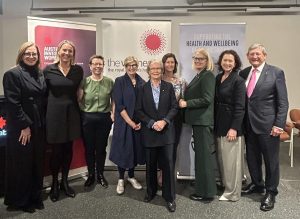
 Connie Blefari (Advisor), Julie Reilly (AIIW), The Hon. Julia Gillard AC, Joyce Teo (AIIW), Catherine Noble (AIIW)
For me, this may be one of the most important lessons from Women Deliver. If we are serious about advancing gender equality, we must invest not only in programs and projects, but also in the relationships, networks and community-led structures that enable people to work together towards a shared vision of change.
Women Deliver reinforced AIIW’s role as a convenor, connector and field-builder within gender-wise philanthropy. More importantly, it strengthened our conviction that lasting change depends on strong relationships, shared learning and collective action.
The conference may have ended, but the work continues. The challenge now is to build on the relationships, insights and momentum generated through Women Deliver and translate them into stronger collaboration, deeper practice and greater investment in gender equality across Australia and our region.
Sometimes the most powerful thing philanthropy can fund is the glue that holds movements together.