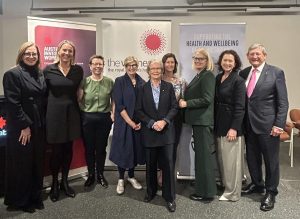
“I remember feeling outraged,” says Carol Schwartz AO (Pictured above with Hayley van Loon), recalling the moment in 2013 that ignited the pursuit of a new horizon for her philanthropy.
“Julie Bishop was the only woman sitting at the Federal Cabinet table – the nation’s premier decision-making table. I was determined to change it.”
Coupling that determination with long-sighted leadership, Carol channelled her energy and a significant philanthropic investment over a decade into what has become one of Australia’s most impactful gender equity initiatives: Pathways to Politics for Women.
Since launching at the University of Melbourne in 2016, Pathways to Politics for Women has supported 752 women across Australia, recorded 97 electoral successes at federal, state and local levels, and currently has 69 alums serving in parliaments and councils nationwide.
It is, literally, changing the face of politics in Australia.
A decade ago, 32% of federal parliamentarians were women. At the opening of the 48th parliament in 2025, 49.6% of federal parliamentarians were women. In 2022, Australia was ranked 64th for women in ministerial positions; in 2025 it had climbed to 8th.
Transformative philanthropy
Supporting and advocating for women in leadership has been a long-standing focus for the Trawalla Foundation, the philanthropic foundation Carol established in 2004 with her husband, Alan Schwartz.
The Foundation works with exceptional individuals and organisations that are focused on strengthening gender equality in leadership, accelerating the climate transition and supporting community building. Growing the number of women in leadership across politics, media, policymaking and capital allocation is a priority for the Foundation which believes that shared power and decision-making leads to better outcomes for everyone.
Acknowledging that none of this happens overnight, Carol says funding to create change at this scale requires a long view and an open mind.
“One of the most transformative things a funder can do is decide to go the distance and really get involved in the work,” she explains. “This means genuinely backing the vision and being willing to adapt and evolve the approach – not just for a few cycles, but for as long as it takes to achieve meaningful change.
“Pathways to Politics for Women is living proof of what becomes possible when philanthropy has that kind of conviction: a decade later we have eight university partners delivering the program in every state and territory, over 750 diverse and amazing alum, and alum now sitting in parliaments across the country.”
 QUT Pathways to Politics for Women (2024) at OGH, EEC and Parliament House. Photo credit: Contact QUT for use.
From a bold idea to a national movement
The inaugural Pathways to Politics for Women program was built in six months. Inspired by Harvard Kennedy School’s From Harvard Square to the Oval Office course, Carol approached then Vice-Chancellor of the University of Melbourne, Professor Glyn Davis AC, with a proposition. By 2016, the first cohort of 24 women had begun the program which became a partnership between the Trawalla Foundation, Women’s Leadership Institute Australia and University of Melbourne.
Each university partner reflects the political context and community needs of its state or territory, guided by local advisory committees that include politicians from across the spectrum. CEO of Trawalla Foundation and National Co-Convenor, Sarah Buckley, who co-leads the non-partisan program with Dr Meredith Martin from the University of Melbourne, says the initiative’s collaborative design has made the model both scalable and genuinely impactful.
“Pathways to Politics for Women uses a unique place-based model,” Sarah explains. “Its genuinely innovative approach leverages multi-year funding, collaboration across eight university partners in every state and territory, and ongoing capacity building through our post-program political mentoring.
“Not only is it helping to redress the ongoing underrepresentation of diverse women in Australian parliaments, it’s become a platform for aspiring and current female politicians from across the political spectrum to drive change in political culture and behaviour.”
From the outset, Pathways to Politics for Women has been intentionally inclusive – running genuinely non-partisan programs for women across the political spectrum, and actively recruiting participants from First Nations communities, culturally and linguistically diverse backgrounds, regional and rural areas, and LGBTQIA+ communities. In 2025, 76% of participants identified with at least one equity group, up from 29% in the program’s first year.
“Diversity remains a priority,” Sarah continues, “and the participation of First Nations women, regional women, and those from culturally and linguistically diverse backgrounds has increased exponentially, strengthening the program’s impact across multiple and intersectional lenses of diversity.”
Dr Rishelle Hume AM, a proud Noongar woman with traditional ties to the Whadjuk, Ballardong and Gnaala Karla Boodja peoples, says the program was a game-changer. “It empowered me to lead with authenticity, connect with trailblazing women, and envision a future where First Nations leadership is front and centre in Australian politics,” she says.
The program’s impact was recognised at the 2021 Australian Philanthropy Awards where it received the Eve Mahlab AO Gender-wise Philanthropy Award presented by Australians Investing in Women (AIIW).
Carol says AIIW’s role in educating and advocating about the far-reaching impacts of gender-wise giving is critical.
“AIIW catalyses and aligns capital across philanthropy and investment so that more of it reaches women and girls, where we know it delivers high impact,” she says.
“We still need strong advocates making the case that investing in women is not charity – it is the smartest thing we can do for this country’s future.”
 Dr Rishelle Hume – WA Speeches in Parliament 2025
Compounding returns
Over the last 10 years, Pathways to Politics for Women has grown its reach without sacrificing depth. Participants receive intensive practical training – including campaign planning, preselection, media, speechwriting and policy – delivered by politicians, advisors, speechwriters and media trainers from across the political spectrum.
Following the program, Pathways to Politics for Women graduates enter a growing national network with access one-to-one mentoring, targeted masterclasses, free access to online social media safety tool Social Protect, and a freely available online Knowledge Hub.
Since 2020, more than 150 mentoring matches have been made between alums who are planning to run for political office and experienced political figures. For many, the program’s ongoing support was the deciding factor between considering a run and actually taking it.
“What was critical was the mentoring that we were able to receive afterwards,” says Cr Sam Choudhury who is currently Deputy Mayor at the City of Stonnington. “Without that, I don’t think I would have run.”
The program’s impact on participants is tangible. Before embarking on the program, just 26% of participants report strong knowledge of how to run for office. By the end of the course, that figure rises to 92%. Confidence in practical skills jumps from 48% to 93%. And the intention to run is high, with 74% of alums planning to seek office within five years, and 89% within ten.
In Victoria, seven Pathways to Politics for Women alums now sit in Parliament representing five different parties. In Queensland, three alums were elected in 2024, helping push the state legislature past 100 women elected to the Legislative Assembly. The program saw its first alum elected to the South Australian Parliament this year and will see its first Senator take her seat in Canberra in August. Alums have served as mayors in Victoria, New South Wales, Queensland and the Northern Territory, and as local councillors in every state and territory.
Beyond the numbers, bringing more collaborative, inclusive and respectful approaches into Australian politics has been a priority for Pathways to Politics for Women and there is growing evidence that change is happening.
In Victoria’s upper house, three Pathways to Politics for Women alums from different parties – Georgie Purcell MLC (Animal Justice Party), Dr Sarah Mansfield MLC (Greens) and Gaelle Broad MLC (Nationals) – say their shared experience of the program underpins a quality of working relationship that is still rare in politics.
“Knowing we’re all alums, there’s that undercurrent – we know that we’re accountable to each other and want to show that there’s a better standard we can aim for in how we interact,” says Sarah. “On those really tough days in Parliament, knowing that your colleagues across the chamber are going to treat you respectfully is really powerful. Pathways to Politics has definitely played a role in that.”
 Cr Sam Choudhury with Victorian alums – 10 year anniversary celebration at Government House (2025)
Non-partisan but unapologetically political
In her address to the Victorian graduating cohort of 2025, alum Hayley van Loon highlighted the program’s impact in fostering a culture of respect and cross-party collaboration.
“This program…put us in a room with women from different parties, philosophies and life experiences – and asked us to do something radical: disagree well,” she says.
“We will disagree. But we should always – always – be pulling for each other’s success. Because when women succeed in public life, Australia succeeds.”
Former Prime Minister the Hon Julia Gillard AC agrees: “We need programs like Pathways to Politics – that special energy that happens when women come together to support each other, to learn from each other, to make sure that they’re ready to step forward into the political world.”
While the long wait for Australia’s next female PM continues, every Pathways to Politics for Women participant, every alum who becomes a political candidate or sitting member and the teams around them, is actively contributing to change.
While Carol Schwartz says seeing an alum of the program become Prime Minister “would be wonderful”, the end goal is less about attaining a position and more about changing the country.
“A real measure of success will be gender-balanced governments becoming the norm at each level, from local councils through to our federal Parliament,” she says.
“Every Pathways to Politics for Women alum who steps up into public office is a step closer to the Australia we know is possible.”

- Read Pathways to Politics alum profiles here
- Download the publication: Pathways to Politics for Women – Celebrating 10 years of Impact