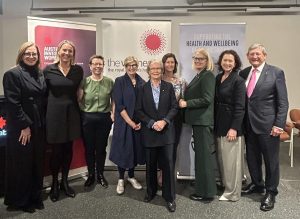
As part of the Women Deliver conference in Naarm (April, 2026), Australians Investing in Women hosted a concurrent session bringing together leaders from across civil society, government, business and philanthropy. The conversation focused on how power is distributed across these systems and what it takes to align them to accelerate progress for women and girls.
The session on ‘Harnessing systems of power as a disruptive strategy for progress’ cut through a familiar pattern in gender equality work.
We often respond with more effort. More programs, more data, more initiatives.
But the constraint is not effort. It is alignment.
As Julie Reilly OAM framed in opening the discussion, lasting progress comes from the combination of grassroots activism and systems-level change. The question is whether those forces are working together, or operating in parallel without impact.
Data is not the barrier
Australia has some of the most advanced gender data systems in the world.
And yet, progress has been slow.
The national gender pay gap has shifted just 7.3% over the past decade, despite sustained activity across sectors. This challenges a common assumption.
The issue is not visibility. It is what happens next.
As Dr Samone McCurdy (WGEA) outlined, “Australia has moved from collecting data, to making it visible, to increasing transparency. The critical shift now is accountability”.
Without accountability, organisations know more, but do not do more.
We can see now that data only drives change when organisations have the capability to interpret it and the incentives to act on it.
Collective leadership matters
There is a tendency to isolate responsibility with individual leaders.
But as Julie Bissinella (Champions of Change Coalition) shared, “CEOs play a critical role in shaping culture, strategy and priorities. But they cannot solve structural issues on their own”.
Gender pay gaps, for example, are shaped by sectoral segregation and care structures. These sit beyond any single organisation.
What has worked in Australia is not just leadership but coordinated leadership.
Over 200 CEOs in the Champions of Change Coalition meet regularly with a singular focus on advancing gender equality. Not within their own organisations alone, but across the system.
The distinction is important. It is not about better leaders. It is about leaders working collectively within systems, not in isolation.
Power sits across systems
Khayshie Tilak Ramesh framed was how power is distributed clearly:
- Civil society names the problem and builds pressure
- Government translates that pressure into policy and regulation
- Business embeds norms through everyday workplace practice
- Philanthropy enables and resources what would otherwise not be funded
Each role is essential. None are sufficient on their own.
When these actors are misaligned, progress stalls. When they move together, change accelerates.
Khayshie reflected, what looks like a “perfect storm” is rarely accidental. It is the result of years of deliberate coordination across sectors.
More than funding
Many activists and movement leaders spend years, often more than a decade, working on issues before receiving any funding.
This raises a harder question for the sector: Is philanthropy enabling systems change, or arriving after it has already begun?
The examples Sarah Buckley (Trawalla Foundation) shared in the session suggest philanthropy is most effective when it:
- Funds early and takes risk
- Enables collaboration across sectors
- Supports long-term, core work rather than short-term projects
In other words, when it helps shape systems, not just fill gaps within them.
Leadership is being redefined
The session also challenged dominant models of leadership.
Work from the Champions of Change Coalition shows that the capabilities required for future leadership are shifting. Inclusion, stakeholder engagement and systems thinking are no longer optional. They are central.
These are qualities often dismissed as “soft”, yet they are increasingly recognised as critical to navigating complex systems.
This is not about women adapting to existing leadership models. It is about leadership itself evolving.
Lisa Annese (Chief Executive Women) added that leadership pathways have historically been built around a narrow model of who work is designed for. Her intervention reframed women’s leadership not as an individual advancement story, but as part of a broader push to redesign institutions around care, inclusion and shared power.
The constraint is power
Across the discussion, one idea surfaced repeatedly:
- We know what works.
- We have the data.
- We have examples of success.
But progress depends on whether power is aligned to act on that knowledge.
For Australians Investing in Women and our community, this reinforces a core principle.
Gender equality is not just a social outcome. It is a systems outcome.
And systems only change when power does.