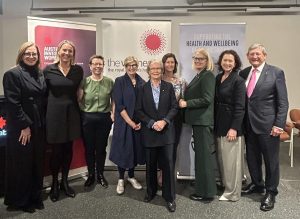
We recently had the privilege of hosting a rich and energising conversation with Angelique Timmer, Regional Director Southeast Asia at Women’s World Banking (WWB).
The session brought together a diverse group of leaders and practitioners across philanthropy, impact investment, development, and gender equality, including Julia Mason (EquityJV; WomenCan), Kylie Charlton (Australian Impact Investments; Giant Leap Fund; Unitus Capital), Manita Ray (Capital Human; ADB; UNDP), Sarah Goulding (GEDSI; IWDA), Seri Renkin OAM (The Dea Network; Coralus), Cathy Scalzo (Scalzo Family Office; ygap; Australians Investing in Women), Julie Reilly OAM (Australians Investing in Women), and Catherine Noble (Australians Investing in Women).
Women’s World Banking in Southeast Asia
With a 45+ year track record and a goal to reach 100 million women globally, WWB works at the intersection of inclusive finance and systems change—operating as both an NGO and an asset manager. Their tripartite strategy spans:
- Applied Gender Research – from climate-health-finance linkages to the financial effects of online gambling on youth.
- Policy Influence – embedding gender metrics into national financial inclusion frameworks (e.g. Indonesia’s gender-disaggregated banking KPIs).
- Private Sector Advisory – partnering with financial institutions and fintechs to design women-centred products, distribution models, and leadership pipelines.
Southeast Asia is a strategic priority, with active programs in Indonesia, Cambodia, and Vietnam. Each context is unique: momentum in Indonesia, slower implementation in Cambodia, and emerging private-sector opportunities in Vietnam.
Enablers of Change
Angelique highlighted three cross-cutting enablers fundamental to advancing gender-inclusive finance:
- Gender-disaggregated data to benchmark progress and drive systemic accountability.
- Digital financial capability—shifting from literacy to practical empowerment.
- Climate resilience products such as disaster insurance and resilience loans.
Shifting Narratives
A consistent theme was the importance of framing. Whether engaging conservative governments through adjacent issues like climate and health, or positioning women as low-risk, loyal customers for fintechs, the business case for gender inclusion remains a powerful lever.
Ecosystem Dynamics
Angelique also shared the rise of women investor circles in Indonesia and across the region—often led by next-generation women in family offices and VC roles. This trend mirrors patterns emerging in Australia, pointing to opportunities for greater cross-border collaboration.
Australia’s Role
Australia’s longstanding commitment to gender equality through DFAT and GEDSI was recognised as a vital point of difference in the global landscape. Opportunities exist for collaboration around climate resilience finance and alignment with the Women Deliver 2026 agenda, where gender and climate intersect.
Closing Reflections
Angelique’s insights remind us that advancing gender-inclusive finance requires:
- Designing systems around women’s realities, rather than asking women to adapt to existing structures.
- Building the case for gender as a driver of economic and market performance, not only equity.
- Connecting purpose-driven women investors globally, particularly across family offices.
- Leveraging policy, finance, and philanthropy as integrated levers for systems change.
At Australians Investing in Women, we are committed to bringing these global insights into the Australian context, ensuring that gender-wise giving and investing continues to evolve as a catalyst for equity and impact.
For more resources, visit: aiiw.org.au/research-resources