Philanthropy has a critical role to play in preventing gender-based violence, yet most funding still responds to crisis rather than addressing its root causes.
At Australians Investing in Women, we see this as a critical inflection point: One where philanthropy can move beyond fragmented responses and invest in long-term, community-led prevention through a gender lens.
Across Australia, communities are searching for more effective ways to prevent family and gender-based violence. Increasingly, one approach is standing out. Place-based models.
Respect Ballarat is an Australian-first initiative using a saturation model, investing over a ten-year horizon to support the Ballarat community in the face of an ongoing gender-based violence crisis. Co-designed by local leaders and organisations, it is built on the strengths already present in the community.
Speaking at the Ballarat Foundation’s webinar, Respect Ballarat: An Australian-first approach to preventing gendered violence, Australians Investing in Women CEO, Julie Reilly, called on philanthropy to take advantage of this opportunity and to ground it’s funding in a gender lens.
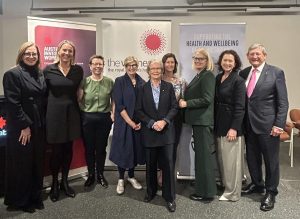
Speaking alongside Respect Victoria CEO, Helen Bolton, and, Women’s Health Grampians CEO, Jennie Courtney, the panel highlighted a critical truth. Gender-based violence does not happen in isolation. It is shaped by the norms, attitudes and power dynamics that sit beneath it.
Place-based approaches, combined with a gender lens, allow communities to move beyond crisis response and address the conditions that enable violence. These include economic insecurity, rigid gender norms and unequal power in relationships.
They also create space for the leadership already driving change.
Jennie Courtney reflected, that this work builds on Ballarat’s long history of civic action and is grounded in the community’s shared experience of grief and collective responsibility to respond.
Ballarat is the first community in Australia to use a saturation model and primary prevention in gender-based violence. Helen Bolton outlined how coordinated prevention activities across the places where people live, work, learn and play, when tailored to place and owned by community, forms a unique opportunity to build a national blueprint for change.
Andrew Earles, CEO of the Ballarat Community Foundation, described this as an opportunity for philanthropy to invest in an Australian-first, evidence-based prevention model, implemented at whole-of-community scale and rigorously evaluated to inform what could be achieved nationally.
But realising this opportunity requires sustained, long-term investment.
Place-based models like Respect Ballarat need a ten-year horizon to embed change, build local leadership, and demonstrate impact at scale. This is where philanthropy has a unique role to play.
Philanthropy can back community-owned solutions, fund prevention rather than only response, and catalyse change that endures and expands rather than duplicating and fragmenting effort.
And when that investment is directed toward women and girls, the impact is multiplied.
Investing in prevention through a gender lens has the potential to reduce the estimated $22 billion annual cost of family violence to the Australian economy, while unlocking up to $128 billion in economic value by removing restrictive gender norms.
A gender lens also makes clear that men and boys must be part of this work. Supporting young men to navigate the pressures of rigid gender norms and build healthy, respectful identities is essential to long-term prevention. Men and boys’ engagement in this work across community, schools, sporting clubs and workplaces is an essential partnership to this work.
When we invest in place, through an intentional gender lens, we are investing in the conditions for all genders to thrive, and importantly for the safety of women and girls. Violence becomes far less possible, and equality becomes far more real.
Australians Investing in Women congratulates Respect Victoria, the Ballarat Foundation and the Ballarat community for their leadership. This is a clear invitation for philanthropy to shift how capital is deployed, from short-term responses to long-term, place-based prevention grounded in a gender lens.
This is more than a local initiative. It is a test case for what is possible when communities, philanthropy and evidence come together with a long-term commitment to change.
The opportunity now is not to observe, but to participate.
If you’d like to continue engaging with this important conversation:
- Explore our Gender-wise Philanthropy toolkit and strengthen society by investing in women and girls.
- Contact Ballarat Foundation to arrange a follow up conversation or a curated visit to Ballarat for your team or board to hear directly from organisations leading prevention initiatives
- Learn how the global evidence proves that higher intensity achieves greater impact with Respect Victoria’s Global Evidence Review by expert Dr Lara Fergus
- Hear from Jesse Park, Men’s Engagement Adviser at Women’s Health Grampians, sharing his thoughts on why Ballarat is ready for Respect Ballarat
Author: Ashley Fairfield, Program Coordinator