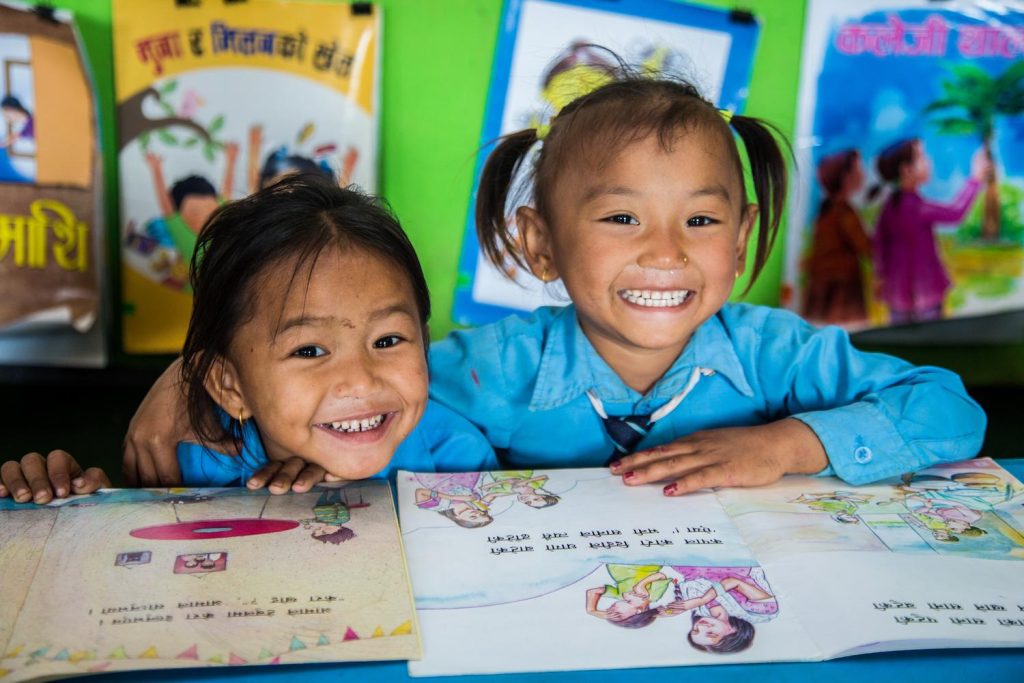
Educating girls is one of the most effective ways to break the cycle of poverty. An educated girl is more likely to stay healthy, earn a higher income, marry later, and raise children who are also more likely to be educated. Yet in many developing nations, girls face enormous barriers to staying in school—ranging from early marriage and gender discrimination to poverty and a lack of supportive role models.
Room to Read exists to change this. Our Girls’ Education Program supports adolescent girls to complete secondary school and develop the life skills they need to make informed choices about their futures. We combine academic support with life skills training, mentorship, and family and community engagement to ensure girls stay in school and thrive.
Life skills—such as self-confidence, critical thinking, goal setting, and negotiation—are vital. They empower girls to make decisions about their education, health, and careers. With these tools, girls are better equipped to navigate challenges and create change not only in their own lives, but in their communities.
Room to Read partners with local educators and community leaders to build environments where girls are supported and gender equality is prioritised. We’ve already supported more than 4 million girls across 17 countries, and 93% of program participants either stay in school, graduate, or enter tertiary education or employment.
Our work is rooted in the belief that educated girls can rewrite the future—for themselves.
Room to Read’s Girls’ Education Program empowers adolescent girls in low-income communities to stay in school, build essential life skills, and become agents of change in their own lives and communities. Our goal is to help every girl realise her right to education and her potential to shape a better future.
We support girls to complete secondary school by providing life skills education, mentorship, material support, and community engagement. These tools enable girls to navigate challenges such as early marriage, gender bias, and economic hardship—barriers that too often force girls to leave school early.
Our She Creates Change storytelling initiative amplifies this impact by sharing real stories of girls in our programs who are driving transformation. These stories challenge harmful norms and show what’s possible when girls are given the opportunity to lead.
We measure success through both quantitative and qualitative indicators. This includes school retention and graduation rates, participation in life skills sessions, and girls’ self-reported confidence and agency. We also engage with families and communities to track attitudinal change and increased support for girls’ education.
Ultimately, we will know we’ve achieved success when more girls not only finish school, but thrive—when they speak up, make decisions about their own futures, and become visible leaders in their schools, families and beyond.
Because when a girl creates change, she inspires her whole community.
Room to Read is committed to transparency, accountability, and continuous learning. We use a robust Monitoring, Evaluation and Learning (MEL) system to collect, analyse and share data on the implementation and impact of our Girls’ Education Program.
Quantitative data includes school attendance, grade progression, graduation rates, and life skills session participation. We also measure changes in girls’ confidence, decision-making skills, and self-efficacy through structured assessments and surveys. Qualitative insights—gathered through interviews, focus groups, and community feedback—help us understand the deeper impact of our program and the cultural shifts it inspires.
We share these findings through regular donor reports, global impact publications, case studies, and interactive dashboards. Lessons learned inform ongoing program refinement and are disseminated internally across country teams to enhance best practices and consistency.
Additionally, our She Creates Change initiative brings program impact to life through the stories of girls who have overcome significant barriers. These powerful narratives, presented through animated films, podcasts, and advocacy materials, allow us to reach wider audiences—including governments, educators, donors, and youth—with stories that inspire and influence.
Room to Read also participates in global education networks and policy forums to share insights and contribute to the broader field of girls’ education. By combining rigorous d
Room to Read is a global nonprofit organization dedicated to transforming the lives of children, particularly girls, through education. Founded in 2000, Room to Read focuses on two primary areas: literacy and girls’ education. With a vision to create a world where all children can lead fulfilling lives, the organization has impacted over 50 million children across 28 countries.
Central to Room to Read’s mission is its Girls’ Education Program, which supports girls to complete secondary school and empowers them with life skills, leadership opportunities, and mentorship. This program directly addresses gender disparities in education, ensuring that girls are equipped with the tools to lead change in their communities. Room to Read’s Literacy Program also plays a pivotal role by developing foundational reading skills and fostering a culture of learning among young children.
These efforts resonate strongly with AIIW’s core values of advancing gender equality and investing in women’s empowerment. By aligning with Room to Read, AIIW is supporting a proven model that not only nurtures educational development but also contributes to breaking the cycle of poverty for girls in low-income communities. Together, Room to Read and AIIW are advancing a future where every girl can unlock her potential and become a catalyst for social and economic change.